Where is my data? Who controls the chain? How much will it cost in six months, and what happens if the rules change overnight? Every organisation that invests in AI ends up asking these four questions. These are the very ones we set out to answer on 19 November at the Carrousel du Louvre, in front of more than 2,000 customers, partners, and developers. For this 13th annual Summit, renamed the OVHcloud AI Summit (see the event programme), the common thread came down to one idea: sovereign AI means mastering an entire chain.
If you weren’t in the room, the AI Summit’s keynote replay lets you watch it again. In the meantime, find below the five takeaways to remember, and what they may change for your own projects.
1. GPUs are no longer a bottleneck
One of the keynote’s most candid moments came from Octave Klaba, our founder and CEO. Over the past three years, many of you have asked us for GPUs without volume limits, and he admitted to the audience that: indeed, we didn’t have enough. We had chosen to keep them for our existing customers rather than use them as a sales pitch. That chapter is now closed. NVIDIA B300 and Rubin GPUs are arriving in both Bare Metal and Public Cloud, across three continents. With 110 megawatts available in our datacentres, we can supply up to 60,000 B300 or 35,000 Rubin GPUs for economically viable projects.
This capacity comes from our model: we build our own servers, construct our own datacentres, cool them with water, and run our own network. Yaniv Fdida, our Chief Product & Technology Officer, made this the theme of his presentation: AI isn’t a product, it’s a stack. That stack runs from the electricity powering the GPU to the application you open every morning. For your own projects, the question is no longer how to get GPUs. It’s how to consume them, in the cloud or on-premises, depending on the level of sovereignty you’re aiming for.
2. The right model, not the biggest one
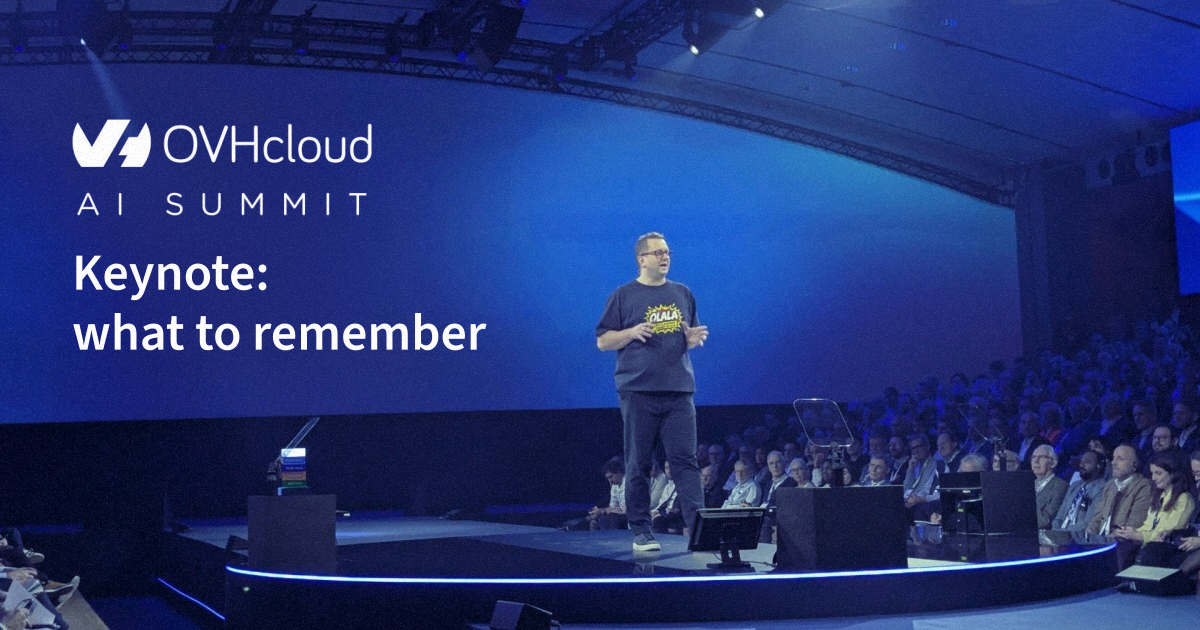
When Octave Klaba unveiled our first, very French, LLM, the audience smiled at first, because yes, we really did call it Olala. But behind the name lies fifteen years of research led at Dragon LLM by Olivier Debeugny, now CEO of our subsidiary OVHai LLM. He had already presented the building blocks of sovereign AI in October at World Summit AI in Amsterdam. Olala is the first model from our OVHai labs, which are also working on voice and document search.
Olala mini was trained on three European public supercomputers and runs on a single CPU server. At Qwant, it already generates the instant answer for 3 million queries a day. There, it uses three times fewer resources than the previous model and responds 20% faster. Yaniv Fdida drew the broader lesson to learn: “The future of inference isn’t one giant model that does everything. It’s the right, specialised model for each business need.” For you, this points to AI with predictable costs, because each task uses the model that’s just enough for it.
3. Agents move beyond the prototype
Back to those two hundred agents. The demo of AI Fabric, built with Blade.sh by Shadow, was a reminder that an agent first needs somewhere to run. Yohann Prigent, CTO of Blade.sh, put it more simply: “An agent without a runtime environment is just a chatbot.”
Two more launches complete the picture. AI Agents hosts, secures, and monitors your agents once they leave the prototype stage, with long-term memory and human approval for sensitive actions. AI Search gives them access to the right passages across millions of your company’s documents. With a single European provider, you now have what you need to take an agent from demo to production.
4. AI for everyday work
Jean-Louis Quéguiner’s return gave the keynote one of its most personal moments. Formerly head of data and AI at OVHcloud, he went on to found Gladia, which joined our group this year. He came back with a conviction: in Europe, voice AI has to understand accents, mixed languages, and those sentences that start in English and end in your own language. We put it to the test on our own phone support, where Gladia voice agents have been handling some of the calls since 1 September 2026.
The same logic applies to OVHai Workspace, presented by Guillaume Gojard, Product Director, and Timothée Rebours, Team Leader. On stage, the tool summarised a thread of twenty emails, found a time slot that suited everyone, and caught up on a meeting that had started without you. That left the question on everyone’s mind: should you trust an AI with your emails and documents? Guillaume Gojard’s answer was that we make “AI work for you, not on you.”. Your data stays in Europe, isn’t used to train models, and the whole Workspace will be end-to-end encrypted in 2027.
5. Sovereign AI is already in production
The final highlight gave the floor to nine customers. AIFE, the French government’s financial IT agency, runs the public e-invoicing platform rolled out in France since September. The platform runs on our Bare Metal SecNumCloud offering and will eventually handle 4 billion flows. Its director, Emmanuel Spinat, summed up the spirit of the session: the era of proofs of concept is over, and it’s time for AI services in production.
IGN, France’s national mapping institute, hosts its Géoplateforme with us, capable of serving up to 55,000 requests per second. The institute is also preparing digital twins of French territories to anticipate the effects of climate change. Skaleet, Ipsos Synthesio, Wiremind, Sekoia, Kbrw, La Poste Santé et Autonomie, and Luganodes rounded out the picture. Their businesses range from banking and healthcare to cybersecurity and logistics. Yet they all come back to the question asked by journalist and speaker Asha Sumputh: who do you trust with your data?
What comes next, we build with you
These five takeaways stem from the vision Octave Klaba, detailed in the opening keynote. For Octave, the real value of AI shows in agentic AI, with agents able to work on a task for hours, or even days. He sees this period as “both exciting and destabilising,” because “all the cards are on the table.” In his view, vision and speed will make the difference. After web hosting, dedicated servers, and the cloud, this Summit marks the start of our acceleration towards AI and quantum. As ever, our ambition is dedicated to sovereign AI, and we are true to this conviction that has guided us for almost 30 years: staying free and independent in our technology choices.
As Octave Klaba promised as he left the stage, we still have plenty to show you. Until then, all the details of our announcements are waiting for you in our article on the 55 launches from the AI Summit. You can also test Olala in its public playground or try OVHai Workspace, whose Productivity space has been open as a free alpha since 19 November.