Many critical SaaS platforms operate under constant pressure: unpredictable API spikes, B2B customers who expect zero downtime, and the risk that one minute offline could snowball into a major incident.
In a recent presentation, Alexandre Buisine (Managing Partner at Enix) and Maxime Lehmann (Product Marketing Leader) at OVHcloud, drew on a real customer case: a B2B SaaS ticketing solution. They used it to show how OVHcloud’s 3-AZ (three availability zones) architecture, combined with Enix’s managed platform layer, can deliver truly resilient infrastructure without unnecessary complexity.
A case study with more to it than meets the eye
The context here: a B2B ticketing platform expected to absorb massive, concentrated spikes in traffic. For the end customer, anything beyond a minute of downtime already counts as a service interruption.
The architecture is built on traditional cloud-native building blocks — load balancers, managed Kubernetes infrastructure, PostgreSQL, Elasticsearch — but the real challenge lies in assembling them so that none becomes a single point of failure. This isn’t unique to this type of application, as high availability is a priority for businesses and systems, well beyond ticketing platforms.
How 3-AZ meets the challenge
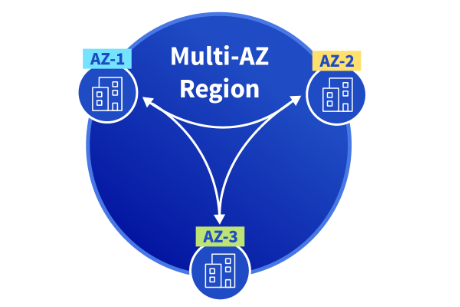
OVHcloud has redesigned its regional infrastructure around physically separated availability zones: three datacentres more than 30 km apart, connected by inter-zone latency of under 1 ms. The goal is simple: if one zone goes down, the application should keep running at full speed, not just stay online.
Not all services behave the same way when a local failure hits:
‘Region’ services, such as Object Storage, managed databases, Load Balancer, public IP, and Managed Kubernetes Service, come with high availability built in. On the other hand, ‘Zone’ services (like traditional VMs) are a different story: it’s up to the architect to handle distribution and failover. 3-AZ isn’t a magic wand, but it does provide a foundation that makes building a resilient architecture far simpler. A Landing Zone — an automated governance framework covering networks, IAM, logs, and monitoring — can also be added to this foundation, ensuring that every component, whether deployed within a single zone or a region, follows best practice for resilience, security and compliance.
Managed Kubernetes Service is another good example of this — showing how both the underlying infrastructure and the PaaS products built on it have become more resilient.
The new MKS Standard service offers an active-active control plane across 3-AZ, with a dedicated 8 GB etcd and capacity for 500 nodes per cluster. On the networking side, nodes are private by default, with a ‘Private Exposure’ API to manage them coming soon. The Cilium CNI, meanwhile, brings improved performance and observability. This case study, with all its details, is available on the CNCF website.
“Resilience is delivered by default, and moving traffic between availability zones costs nothing extra.”
Maxime Lehmann, Product Marketing Leader, OVHcloud
Beyond infrastructure: what about operations?
A well-designed 3-AZ setup removes the risk of unavailability, but not the day-to-day work that comes with it: version upgrades, configuration drift, incidents to sort out, and trade-offs around timing. Infrastructure resilience doesn’t solve the problem; it just shifts it onto the operations side.
This is especially true for customers who want more than technical robustness. They want to hand over the entire operation, right up to the application layer, so they can focus purely on their core business. The rise of agentic AI is likely to reinforce this trend even further.
What Enix brings: an infrastructure transformed into an operated service
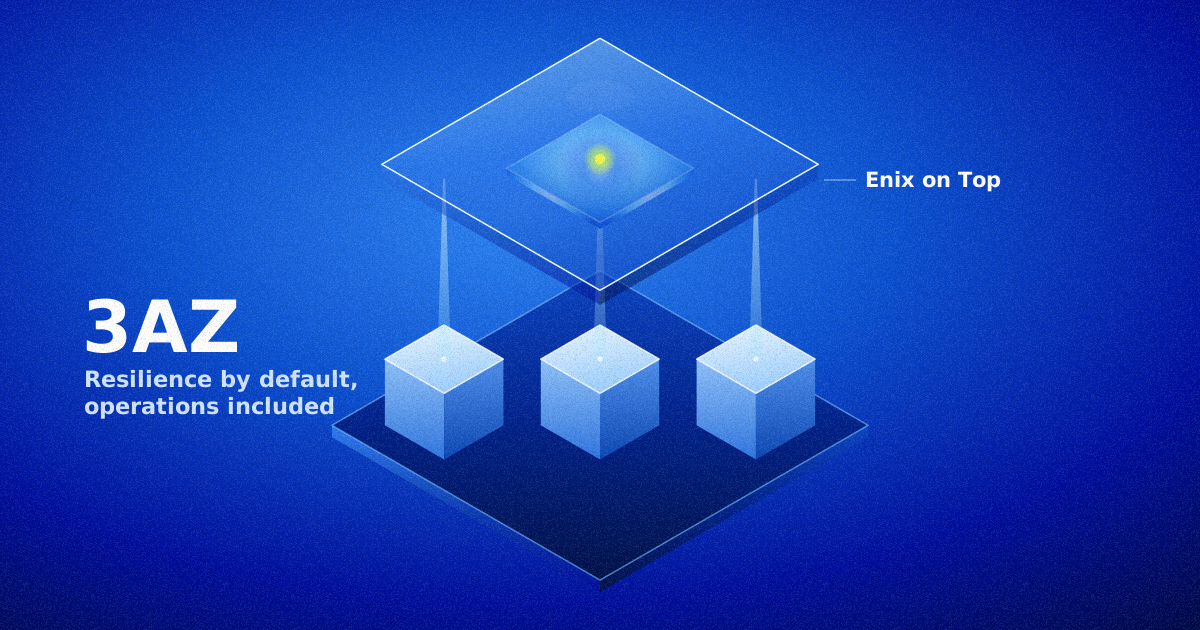
A resilient infrastructure alone isn’t enough to guarantee the maintenance of a service over the long term. Aside from the extra capabilities (observability, security, or custom development) provided where needed, the ‘Enix on Top’ layer takes care of day-to-day project management, and offers human support: 24/7 troubleshooting from senior engineers, migration monitoring, and FinOps oversight.
“We offer more than just infrastructure; we provide a highly available end-to-end service with a single point of entry for operations.”
Alexandre Buisine, Managing Partner at Enix
From kick-off to live in under four weeks
One of Enix’s strong points is how quickly things can be set up. The process involves five simple steps:
- Kick-off
- Enix approves the global purchase order (infrastructure and services)
- The infrastructure is delivered by OVHcloud
- ‘Enix on Top’ layer is deployed
- Launch
In some cases, this entire cycle can be completed in under a month, a turnaround that contrasts sharply with internally run HR projects, which can take much longer.
This is mainly down to the sheer number of contacts and approvals involved, or other projects running in parallel that make it impossible to dedicate 100% of your time to a single task.
To sum up...
What emerges from deployments across multiple availability zones is a shift in focus: high availability is no longer seen as a costly, bespoke engineering effort for large organisations, but as an inherent capability of cloud infrastructure.
OVHcloud lays the technical groundwork with 3-AZ, including physical isolation, automatic replication across regions, and a contractual SLA. Enix, in turn, bridges the gap between the theoretical infrastructure and a service that is actually operated and monitored service on a daily basis.
The question remains: would your architecture stay up if your datacentre went down right now? If the answer isn’t an immediate ‘yes’, it’s probably time to see what 3-AZ (and the support that comes with it) could change for you.