The .si domain super intelligence rush, explained
Two letters made the domain news at the end of September. Slovenia's country extension, .si, suddenly matched the new U.S. government shorthand for artificial intelligence, and registrations surged within hours. If you manage a brand online, the .si domain super intelligence rush raises a simple question: is your name still yours in .si? Here's what happened, what the numbers show, and what's worth doing now.
## What's going on with .si?
On September 22, President Trump told the UN General Assembly that the United States would call AI "super intelligence", or SI. A week later, on September 29, he signed Executive Order 14434, which asks federal agencies to use "Super Intelligence" and "SI" in official correspondence, websites, reports, and other non-statutory documents.
The order changes vocabulary, not law. For its purposes, SI covers exactly the technologies already defined as AI in U.S. federal law, and existing statutes, regulations, and contracts stay unchanged for now.
The link with domains is a coincidence of letters alone. Every country has a two-letter internet extension, called a country-code top-level domain (ccTLD), and .si belongs to Slovenia. If you'd like a refresher on how extensions work, our guide on what a domain name is covers the basics. Unlike some national extensions, .si is open to any person or organisation, wherever they're based.
## The .si domain super intelligence effect
Security firm Netcraft, which tracks domain registrations worldwide, found that new .si registrations overtook .ai ones within 25 hours of the UN speech. The order then sped things up: daily .si registrations more than doubled compared with the week before it was signed.
The registry's own statistics, as reported by Netcraft, tell the same story. About 13 times as many .si domains were registered in September as in August. The 24-hour count climbed from 4,794 on September 23 to 13,603 on October 1, and the total number of .si domains grew by 21.6% in eight days.
Register.si, the organisation that manages the extension, describes the activity as unprecedented, but is reticent to identify its cause. Its spokesperson told the BBC that the increase shouldn't be attributed solely to the US announcement.
## Speculators and lookalikes
The pattern is familiar. When Anguilla's .ai took off, it became the default extension for AI companies and a significant source of revenue for the territory. Many of today's buyers are betting that .si could follow the same path.
Part of the demand is plainly speculative. Netcraft found that just over half of the .si domains it tracked at one registrar in the days before the UN speech were already listed for resale. Some of those names belong to well-known brands, registered by people who don't own those brands.
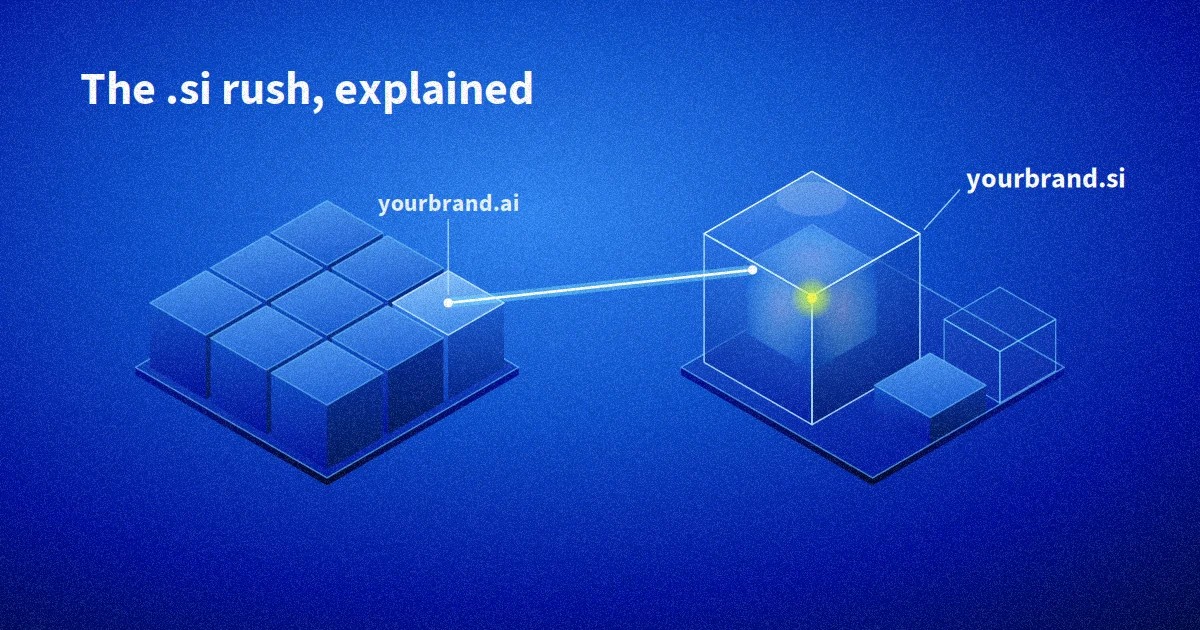
A second risk comes from the keyboard. On a QWERTY layout, "s" sits next to "a", so a .si address is one keystroke away from its .ai equivalent. Netcraft counts more than 44,000 names that exist in both extensions, about 22% of all .si domains. That's fertile ground for typosquatting, the practice of registering a near-identical address to catch mistyped visits or lend credibility to phishing campaigns.
For now, fraud on .si remains low, and Netcraft hasn't detected a rise in phishing linked to the rename. The risk grows if "SI" catches on, which is why acting while names are still available makes sense.
.si vs .ai: what's the difference?
Many buyers are betting that .si will follow the path of .ai. Today, the two extensions still differ in three ways.
The first is availability. Tech companies have used .ai for years, so most short, meaningful .ai names are already taken. In .si, many of those names are still free.
The second is price. At OVHcloud, a .si domain costs £12.86 ex. VAT for the first year and £12.69 ex. VAT to renew. A .ai domain costs £61.09 ex. VAT for the first year and £103.19 ex. VAT to renew, and you must register it for at least two years.
The third is recognition, and here .ai still leads. People already link .ai with artificial intelligence. Whether they'll make the same link with .si depends on how widely "SI" catches on outside U.S. government documents.
Should you register a .si domain now?
It depends on why you want one. If you own a brand, the answer is yes: registering your name costs little, and it keeps it out of the hands of speculators and typosquatters. The next section shows what to check.
If you're building an AI product, .si can also work as your main address, especially if the name you want is gone in .ai or priced out of reach. Keep in mind that the link between .si and AI is only a few weeks old.
Buying names only to resell them is a different bet. Plenty of sellers got there first, and nobody knows yet whether "SI" will stick.
Securing your brand in .si
You don't need to bet on the future of "SI" to protect your brand. A few checks cover the essentials.
- Search for your brand name in .si, along with your main product names. Registering them now is usually simpler than trying to recover them from a third party later.
- If you already use a .ai address, consider securing its .si twin, since it's the most likely typo of your address.
- Check whether lookalikes of your name are already registered, and keep a record if any of them points to suspicious content.
- Once your domain is registered, it's worth enabling DNSSEC, which protects its DNS configuration against cache poisoning. Our DNSSEC guide walks you through the setup.
If a name you want is already taken, our series on domain names explains why that happens and what your options are.
What comes next
Whether "Super Intelligence" spreads beyond U.S. federal documents or fades with the headlines, the .si domain super intelligence rush has already changed who holds which names. The next signal to watch is the order's 60-day deadline for a federal definition of SI, which falls at the end of November. In the meantime, the simplest move is to check .si availability for your brand and secure the names that belong to you.