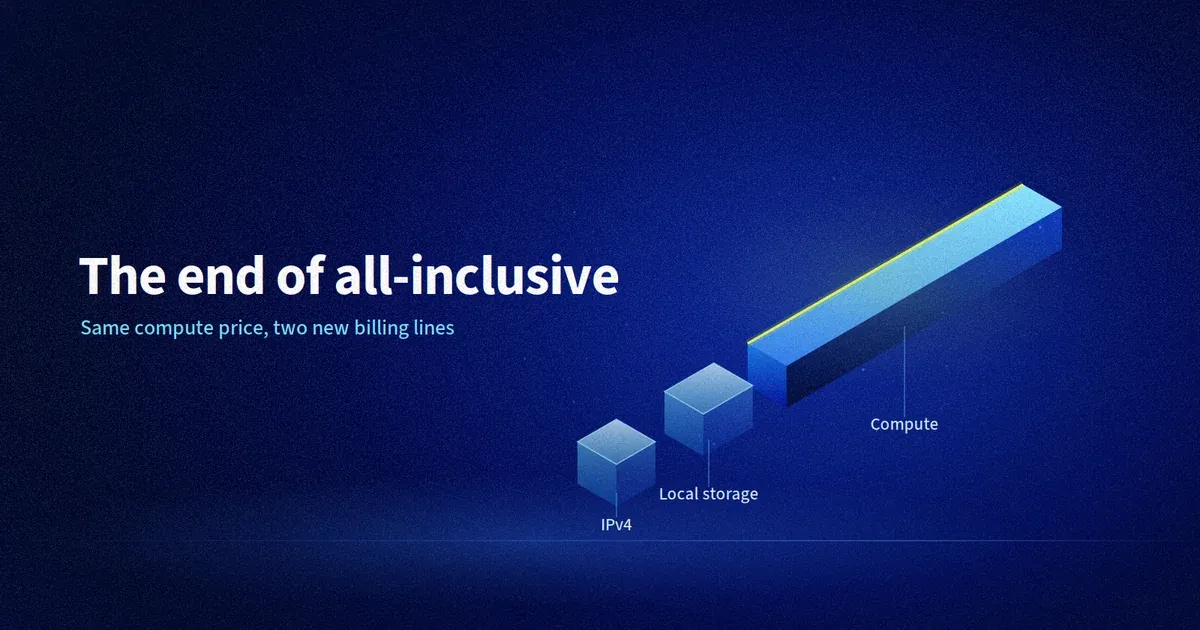
Our Public Cloud instances have historically included local storage and a public IPv4 address in the same price. From October 1st, 2026, these two resources will become separate billable lines. The price of the virtual machine, or the compute, will not change.
With memory and storage costs rising, our goal is to minimize this impact on you. This means being able to choose what you actually need and in what quantity.
Even at the same configuration, your bill will increase. But you can act now: free up an unused IP address, choose a Flex instance that only takes up 50 GB of local disk, and add some remote Block Storage. Depending on your usage, the increase may be incremental at most.
This article goes over what is changing and why. For details on pricing, per instance, please see this second article.
Why we are changing our model
There are two reasons for this new development.
Allowing easier comparison
Since the beginning, our instances have automatically included resources that the market’s big players charge for separately: local storage and a public IPv4 address. This choice was made for simplicity. But we have found that it has become a disservice to our customer.
When a customer puts two prices side by side, they are comparing two numbers, not two scopes. Ours may seem higher because it contains more; this actual advantage becomes invisible, when it should be seen and understood.
By now billing local storage and IP addresses separately, we are aligning our model with the market. Each line becomes more legible to you and comparison becomes easier, line by line, when comparing the same scope. It's a matter of transparency, but also of coherence and clarity: we want our positioning to be verifiable on an invoice, and not requiring of extra explanation.
Keeping the calculated price
The surge in artificial intelligence has led to huge demand for graphic processors, known for their high memory requirements. As such, the three major global manufacturers have redirected their factories to high-performance memory, at the expense of the standard DDR5 that equips our servers.
Since we design and assemble our servers ourselves, we buy these components directly from the manufacturer, without any intermediary. Buying memory costs us six times more today than it did a year ago, and storage is following the same trajectory.
How much price rise are we talking about?
Between a 1.4% and 21.9% increase, depending on your size, with storage capacity unchanged.
The difference between these two numbers can be easily explained. Local storage is capped at 400 GB and the IP address costs a fixed amount, so the increase is almost the same, in euros, for all instances. For those of smaller scale, this amount may weigh more heavily. For the bigger scale, the increased amount becomes marginal. You can find price breakdown examples, instance by instance, in this article.
We chose to take this path rather than a general increase in the price of instances, because it makes each item more visible and actionable: for example, an IP address that serves no purpose can be released, or an oversized volume can be reduced.
Local Storage becomes its own class of Block Storage
On Generation 3 instances, B3, C3, and R3 families, local storage is no longer included in the instance price. It is billed 0.0001458 € ex. VAT per GB and per hour, or about 0.11 € per GB and per month, or 109 € per TB and per month. On all previous ranges (B2, C2, R2 and earlier), it remains included.
By exiting the instance price, this local NVMe disk does not become just an additional line on the invoice: it becomes a storage class, the Local Low Latency Storage class, backed directly to the NVMe disk of the server that hosts your instance. It is available on all our Generation 3 instances and is particularly popular for database storage.
This class adds to our existing Block Storage classes, backed by our distributed storage and designed for high availability, and which remain unchanged. It’s up to you to choose based on your workload: lowest latency with local NVMe, availability with distributed storage, or both on the same instance.
Today, capacity is still fixed by the size, just like in our current catalogue (50, 100, 200 or 400 GB depending on the instance). We are working on an evolution that will allow us to size this storage independently per the size of the instance, and even to start an instance without a local disk directly on the classes Block Storage Classic and High Speed. We do not have an announcement date set for now, but we wanted to inform you of the direction we are taking going forward.
Our other storage solutions, high-availability Block Storage, Object Storage and File Storage, will not be impacted by the price change.
The public IPv4 address becomes optional
This option is billed at the rate already applied to our Floating IP, at 0.0027 € ex. VAT per hour, which is about €1.97 per month. Billing is per second for all Public Cloud VM ranges and the Gateway, including when the address is not attached to an instance.
A dedicated section of the Manager allows you to create, attach and release your addresses as soon as you no longer need them.
If you wish to limit the number of public IPv4 addresses billed, a 100% private network architecture remains the most efficient solution: it pools the outgoing traffic of your instances behind a single IPv4 address, that of your Gateway, rather than one per instance. Learn how to configure a gateway on your private network.
Savings Plans are also evolving
Here too, we seek to become more easily comparable. The market generally offers two commitment periods: 1 or 3 years. Formerly, we offered five, from 1 to 36 months. This profusion was intended to be flexible, but it produced grids that were difficult to compare with those of another supplier. From October 1, 2026, the 1, 6 and 24-month terms will no longer be available for subscription, but the 12 and 36 months remain.
| Duration | Discount |
|---|---|
| 12 months | 15% off |
| 36 months | 30% off |
These rates are lower than before. A commitment allowance is based on our ability to amortize a known upfront capital investment. With memory being six times more expensive than a year ago, and component forecasts that nobody commits to beyond a few weeks, committing to three years at a heavily discounted rate is unrealistic for us in an unpredictable market. We therefore prefer offering a more modest discount now, so we don't have to retract our offer due to market conditions at a later date.
And yet, we remain significantly cheaper: even after this development, our price commitment remains approximately twice as low as that of the market leader, compared to three times lower previously.
The discount applies to the compute. Local storage and IPv4 addresses are billed at their actual price, excluding the discount, for the entire duration of your plan.
What your Savings Plan guarantees
Two regimes coexist, but they do not guarantee the same thing.
If you subscribed to a Savings Plan before the new pricing, two things are guaranteed: the price of the instances and the discount percentage. This price is fixed for the duration of your commitment. However, local storage and IP addresses, now billed separately, are not covered by this guarantee. As of October 1, 2026, they will be charged at the current rate, even if your commitment is still in progress. Then you will be switched to the new grid at the time of renewal.
If you subscribe to the new grid, it will be the percentage discount that is guaranteed, applied to the catalogue at the current prices. Your rate is locked in for the entire duration. The catalogue price, on the other hand, remains the current price: if it changes, your invoice will follow, but the discount is retained.
A Savings Plan guarantees a percentage discount on a public price.
Change schedule
| Date | Step |
|---|---|
| End of August 2026 | Update of the prices on the website |
| September 1, 2026 | Launch of the new Savings Plans Instances grid, informing of the clients concerned |
| October 1, 2026 | Local storage and IPv4 address billed separately |
What’s not changing
The hourly price of instances. The performance of our network. Powerful anti-DDoS included. Outbound traffic included. And our sovereign, European cloud.
Since our last announcement, we have deployed per-second billing, generally available Public Cloud File Storage, and launched a discovery offer for managed databases. VPC, WAF, VPN as a Service, and Savings Plans for our Databases are coming soon.
To learn more: discover the breakdown of the rates, instance by instance, and the precise impact on your invoice in Public Cloud: Pricing changes as of October 1, 2026.