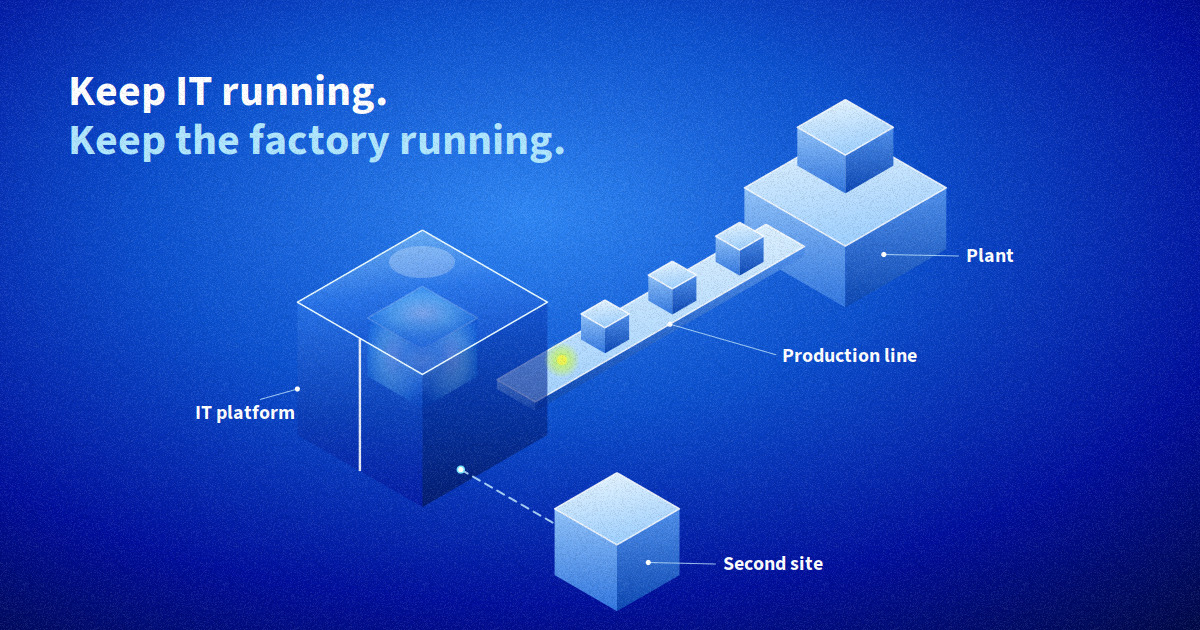
Ask a plant manager what happens when the ERP stops responding for an hour. The answer comes straight away: the line slows down, orders pile up, and someone starts calling customers to reschedule deliveries.
Over the past few years, information systems have moved into the heart of production, and operational resilience in manufacturing now depends on them. MES (manufacturing execution systems), analytics, sensors, and AI applications talk to the machines in real time. It’s a big step forward with a very concrete consequence: when IT stops, the factory stops.
The context has also become more complex. Manufacturing has been the most targeted industry for cyberattacks for five years running, according to IBM’s X-Force Threat Intelligence Index 2026. Rising cloud costs and geopolitical instability add to the pressure, and European rules such as NIS2 and the AI Act are coming into force in stages, adding new security and compliance obligations.
Five trends reshaping industrial IT
- Resilience becomes a competitive advantage
Downtime now hits production continuity, deliveries, and customer commitments, so teams build multi-site architectures that keep operations running. For ERP, MES, and supply chain systems, high availability and disaster recovery are now production requirements rather than IT extras. - Cloud needs predictability and choice
The first wave of cloud adoption brought speed and scalability. The second is about control, as higher bills, vendor lock-in, and unpredictable economics push companies to rethink their strategy. In Flexera’s 2026 State of the Cloud Report, 85% of organisations say managing cloud spend is still one of their top challenges. The question is no longer whether to use cloud, but where each workload should run: public cloud, private cloud, bare metal, or a hybrid model. - AI works best close to the data
Predictive maintenance, quality control, and digital twins deliver results when compute, data, and equipment work side by side. In practice, that means GPU-ready infrastructure, low latency, and storage that scales with production. - Sovereignty becomes an operational matter
Knowing where production data lives and who runs the infrastructure protects know-how, suppliers, and customers. AI models and intellectual property carry the same stakes, which puts location, access, and governance on a par with performance. - Modernisation happens step by step
Legacy systems coexist with cloud and AI, while plants keep running. ERP, MES, PLM (product lifecycle management), and virtualised environments have to work alongside cloud-native platforms, so moving one workload at a time keeps risk under control.
Building operational resilience in manufacturing
The common thread is taking back control of the infrastructure. With OVHcloud, each application can find the environment that suits it best: Hosted Private Cloud or dedicated servers for ERP and MES, GPUs for AI, object storage for backups and archives. And when hosted in OVHcloud’s European datacentres, industrial data stays in Europe, under clear access rules.
Some companies have already started. Arcade Beauty brought the IT of its five European production sites together on one Hosted Private Cloud platform, and senseering built a marketplace on OVHcloud where companies can buy and sell machine data, for example to train predictive maintenance models.
If you lead IT in a manufacturing company, the challenge now is choosing your own path to modernisation while keeping operations running, data under control, and costs predictable.
To see where your own infrastructure stands, visit our page on operational resilience in manufacturing. You can download a free guide that covers the five trends in detail, with customer stories, and book a free assessment with our partner Stefanini to check how your critical systems hold up against downtime.