At OVHcloud, we host more than 6 million websites, and more than 80% of them run on WordPress. A number that size tells you that what it takes to keep a WordPress site healthy has changed a great deal over the years. To anticipate this shift, we developed Managed Hosting for WordPress. This article details what managed WordPress hosting means, and why we built it the way we did.
One tool, very different use cases
This figure above is culminated from a huge variety of projects — ranging from a freelancer’s first website to the showcase site of a small business, to an online store, to a media outlet — and more. As thousands of web agencies and freelancers grew with OVHcloud, they also built and maintained WordPress sites for their clients. And that’s what makes WordPress so invaluable: the same tool can support very different projects, and grow with each of them.
The real work starts after go-live
For quite a long time, web hosting expectations remained rather simple: to provide the resources a site needs to run.
But today, the real time-consuming challenge can often begin after the site is live, as a user needs to keep WordPress, themes, and plugins up to date. Of course, you need to preserve performance as content and traffic grow, to protect your site against attacks, back it up, and, increasingly, to run several projects in parallel.
But if you own a single site, it’s that time and technical know-how you’d rather spend on your business than on maintenance. And if you run an agency, or work freelance, those few minutes of upkeep, repeated across dozens or hundreds of WordPress sites, quickly add up to hours every week.
And this is how the idea behind the need for Managed Hosting for WordPress was born.
What Managed Hosting for WordPress is designed to do for you
The goal of our managed hosting offer is to automate the technical chores that fill your week. It isn’t designed to turn WordPress into a closed platform; on the contrary, we intended it to safeguard the freedom of movement and choice that makes it so strong.
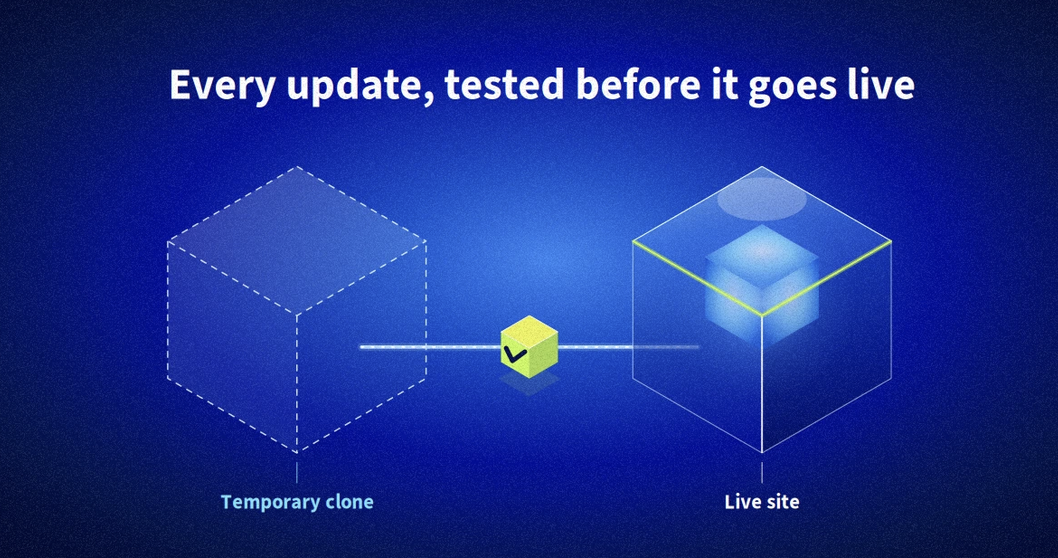
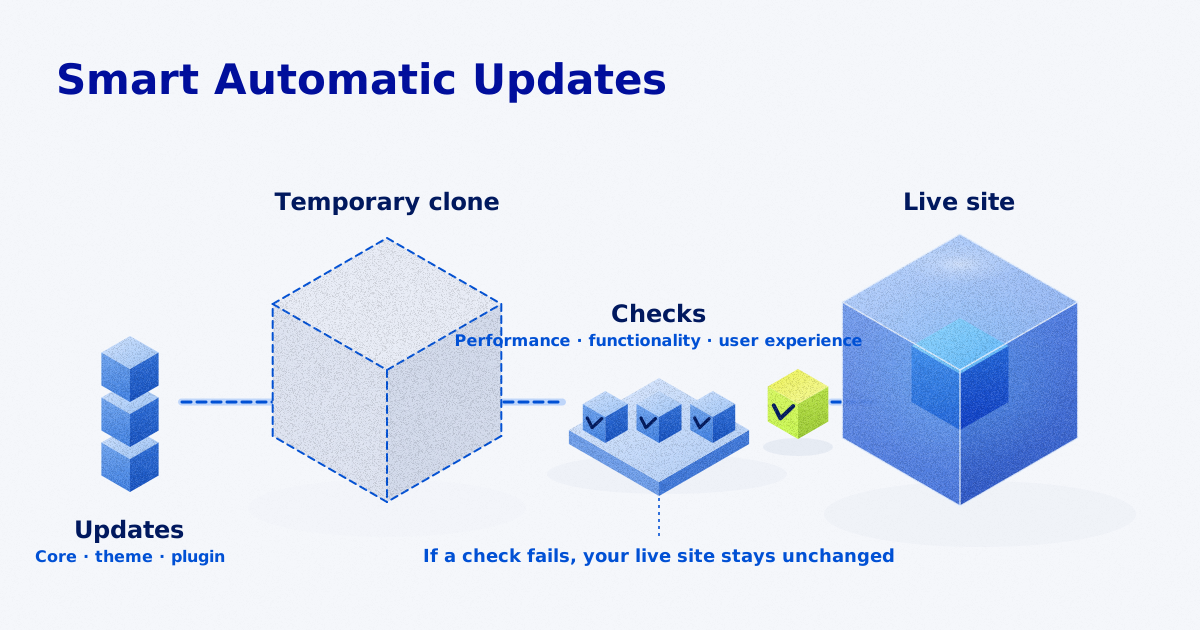
Take the concrete example of Smart Automatic Updates: before any update were to reach your live site — whether it’s WordPress core, a theme, or a plugin — it’s first applied to a temporary clone. That clone is checked for performance, functionality, and user experience. If everything passes the test, the update goes live. If something breaks, your live site stays exactly as it was. You receive a notification explaining what went wrong, with a link to the cloned site so you can investigate the issue and relaunch the update once it’s resolved. You get up-to-date sites without the usual gamble on every release.
Performance, backups, security, and site management are also grouped into a single environment. And if you manage several WordPress projects, a centralized dashboard lets you find, update, and manage all your sites from one place, rather than logging into each one in turn.
And we follow a key principle of freedom that matters to us, and to you: your data stays your data. And you are free to retrieve it at any time, and to host it elsewhere. What Managed Hosting for WordPress covers, in general terms, is worth reading if you’re weighing it against another plan; please refer to the Managed Hosting for WordPress guide if you’d like a more in-depth understanding.
As WordPress evolves, so does our role
We believe that a host’s role should go beyond providing resources, and extend into making life simpler for the people who create and maintain websites — while leaving them in control of their sites.
This is the balance we’re building with Managed Hosting for WordPress. Having fewer repetitive tasks leaves you more time to create, develop, and grow your projects. And of course, we build with your help: it’s the agency, freelancer, and site owner feedback from WordPress users that shapes what we automate next, and what we leave up to you to manage.
Where we go from here
Hosting a WordPress website is no longer about disk space and uptime alone. Managed WordPress hosting is about absorbing the daily maintenance so that your time goes to advancing your projects, not to your update queue, without surrendering the openness that made you choose WordPress in the first place.
If this is the type of the beneficial trade-off you’re looking for, discover Managed Hosting for WordPress and see how it fits your sites, whether you’re running one or one hundred.