Nowadays, every cloud provider says it's green. Some are able to back their claim with audited figures, others with just a pledge and a leaf icon. If sustainability is one of your selection criteria, you will need a reliable way to tell cloud providers apart.
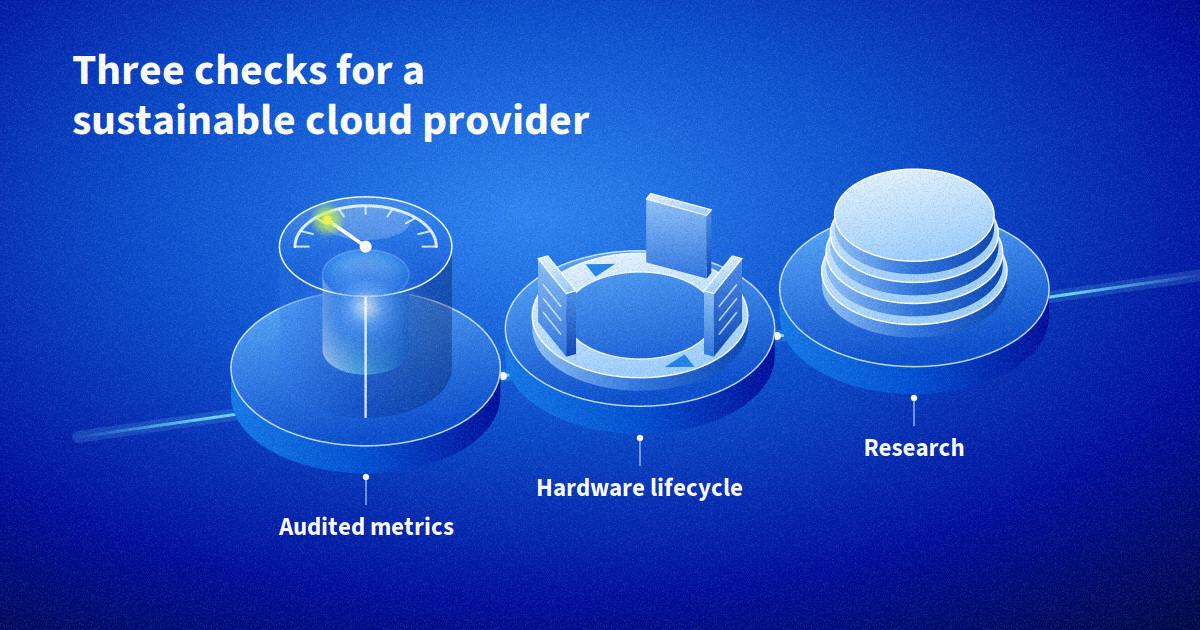
This guide gives you three criteria that will help you assess a sustainable cloud provider: how it measures its impact, how it manages hardware across its lifecycle, and whether it invests in research to go further. For each one, you'll find the questions worth asking and a concrete example from OVHcloud with FrugalCloud, a research challenge run with Inria.
Why green claims are hard to compare
The stakes are real. In Europe, digital technology accounts for 2% to 3% of electricity consumption, and datacentres represent nearly half of that share. With the rise of AI, the sector's share of carbon emissions is expected to double, or even triple, by 2030.
Yet comparing providers is harder than it should be. Metrics change from one report to the next, some carbon footprints leave out the emissions from manufacturing servers, and labels like "carbon neutral" rarely come with a published method. Two providers can both claim to be green while measuring completely different things.
The way through is to look for evidence that is verifiable. If you want a deeper dive into carbon metrics and their common biases, please consult our guide to the carbon impact of cloud services, which covers them in detail. As well, find three criteria below that will help give you a broader framework for choosing a sustainable cloud provider.
Measure with standard, audited metrics
A provider that takes sustainability seriously measures its impact with indicators that anyone can compare. For datacentres, the ISO/IEC 30134 family of standards defines the main criteria.
Three indicators worth knowing
- PUE (Power Usage Effectiveness) compares a datacentre's total energy use with the energy used by its IT equipment. The closer to 1, the less energy goes to cooling and other overheads.
- WUE (Water Usage Effectiveness) measures the water consumed per kilowatt-hour of IT energy. The closer to 0, the better.
- Decarbonized energy rate gives the share of decarbonized energy powering the datacentre.
A single headline figure isn't enough. It's worth checking whether values are published site by site or only as an average, whether they cover a full year, and whether an independent body has audited them.
What OVHcloud publishes
OVHcloud reports these indicators in line with the ISO 30134-2, -3, -8, and -9 standards, and Apave Exploitation France has audited them against those standards. PUE is measured over 12 months and covers 88% of the datacentres OVHcloud owns and operates.
For fiscal year 2025, the group's PUE stands at 1.24 on average, with a published minimum of 1.15, down from 1.26 in 2024 and 1.29 in 2023. Its WUE is 0.34 L/kWh, and its decarbonized energy rate is 100%. Values are also published for each of nine datacentres in Europe and North America, so you can see how individual sites perform rather than relying on a group average.
These results rest on choices made over two decades, such as proprietary water cooling since 2003 and server rooms without air conditioning since 2006. OVHcloud has also shared its carbon footprint every year since 2017.
When you assess a provider, here are the questions to ask:
- Which standards do your indicators follow, and who audits them?
- Do you publish values per datacentre, over a full year?
- Does your carbon footprint include Scope 3 emissions, such as server manufacturing?
That last question matters more than it seems, as the next criterion demonstrates.
Act across the whole hardware lifecycle
Electricity is only part of the story, because building servers has a heavy footprint too. A low PUE shows how efficiently a datacentre runs once it's built, but it says nothing about the footprint of manufacturing the hardware in the first place. A provider that only optimises energy use leaves a large share of its impact untouched.
An integrated industrial model makes a real difference here. OVHcloud designs its own servers and builds them in two factories, one in France and one in Canada. That control over the production chain makes a circular approach possible:
- Servers are designed to be taken apart, with components chosen for easy repair, reuse, and recycling.
- Every server is disassembled at the end of its use, and each component is tested to find its best second life. Today, 17 out of every 100 components in OVHcloud servers are refurbished.
- Servers stay in service for 4.5 years on average, and up to nine years, which avoids part of the emissions from manufacturing new hardware.
- Servers move between datacentres to meet demand, rather than being replaced by identical new machines.
- Of OVHcloud's datacentres, 27 are rehabilitated buildings, which avoids the footprint of new construction.
- Components that can't be reused go to certified partners, who turn them into new sources of raw materials.
The same logic reaches suppliers, who sign a Supplier Code of Conduct, while OVHcloud adheres to the principles of the UN Global Compact and the conventions of the International Labour Organization. Infrastructure keeps improving as well. The new Smart Datacenter cooling system cuts power consumption by up to 50% across the cooling loop and uses 30% less water than OVHcloud's earliest design.
Questions worth asking any provider:
- Do you build or refurbish your own hardware, and what share of components is reused?
- How long do your servers stay in service on average?
- What happens to equipment at the end of its life?
Measuring well and managing hardware responsibly are today's work. The third criterion looks at how a provider prepares for what comes next.
Invest in research to go further
Efficient datacentres and long-lived servers solve part of the problem. The next gains depend on questions that remain open, such as how to write cloud software that uses less energy, or how to help customers reduce the impact of their own usage. A provider committed for the long term puts research effort into these questions.
FrugalCloud is one example. Launched on 1 October 2021, this joint challenge brings together OVHcloud and five project teams from Inria, the French national research institute for digital science and technology: Avalon, Inocs, Magellan, Spirals, and Stack. It draws on leading French researchers in sustainable and distributed computing, under the scientific leadership of Laurent Lefèvre, an Inria researcher at ENS de Lyon and a long-standing specialist in the energy efficiency of large-scale systems. The challenge will end in 2027.
The work follows three research axes:
- Eco-designing cloud software and services, by bringing energy and environmental metrics into how cloud applications are built, for example stream processing and microservice architectures.
- Activating efficiency levers in datacentre hardware, with algorithms and software that use the reconfiguration and energy-saving options of servers, storage, and network equipment, tested at real scale.
- Helping cloud users reduce their impact, by exploring new models such as pricing schemes and optimised service catalogues that encourage lower-impact use of cloud and bare metal services.
These axes are split into seven sub-projects, most of which pair two Inria teams with one or more OVHcloud teams. Results so far include a study of the energy consumption of stream processing engines, a comparison of software-based power meters, and PowerHeat, a non-intrusive method for estimating power consumption. Other work shows how to run more virtual machines per server without hurting performance, or how pricing models can encourage lower-impact use of the cloud.
On the scientific side, the challenge has enabled six PhD theses and one postdoc, with more than 15 research papers published. It also led to the organisation of two autumn schools, ECO-ICT 2024 and ECO-ICT 2026.
On the operational side, OVHcloud is now industrialising the output of SP7, the sub-project on observing the electricity consumption of bare-metal servers. This work has two objectives:
- Feeding the Environmental Impact Tracker, so that environmental impacts are measured as close as possible to the actual usage of OVHcloud services.
- Measuring PUE 3, the most advanced level of resolution available today.
"Our customers have increasingly demanding environmental objectives. By combining OVHcloud's expertise with that of Inria's research teams, FrugalCloud is improving the efficiency of our cloud and giving our customers the indicators they need to control and reduce the footprint of their usage," says Maxime Agusti, Ph.D., IT Technical Leader at OVHcloud.
You can follow the publications and talks on the FrugalCloud project site (french article). It's also worth asking any provider whether it runs or funds sustainability research, with which partners, and whether the results are published.
Your sustainable cloud provider checklist
Before you shortlist a provider, run through these three checks:
- Measure: indicators follow ISO 30134 standards, are published per datacentre, and are independently audited.
- Lifecycle: the carbon footprint includes manufacturing, and the provider reuses components and extends server lifespans.
- Research: the provider invests in long-term research, ideally with public partners and published results.
A provider that meets all three gives you more than a claim. It gives you evidence you can check and track over time.
Check the evidence yourself
A genuinely sustainable cloud provider doesn't ask you to take its word for it. It measures its impact with standard indicators, acts across the whole hardware lifecycle, and invests in research to go further. The best place to start is the numbers, so review OVHcloud's environmental indicators and reports, site by site, and hold every provider on your shortlist to the same standard.