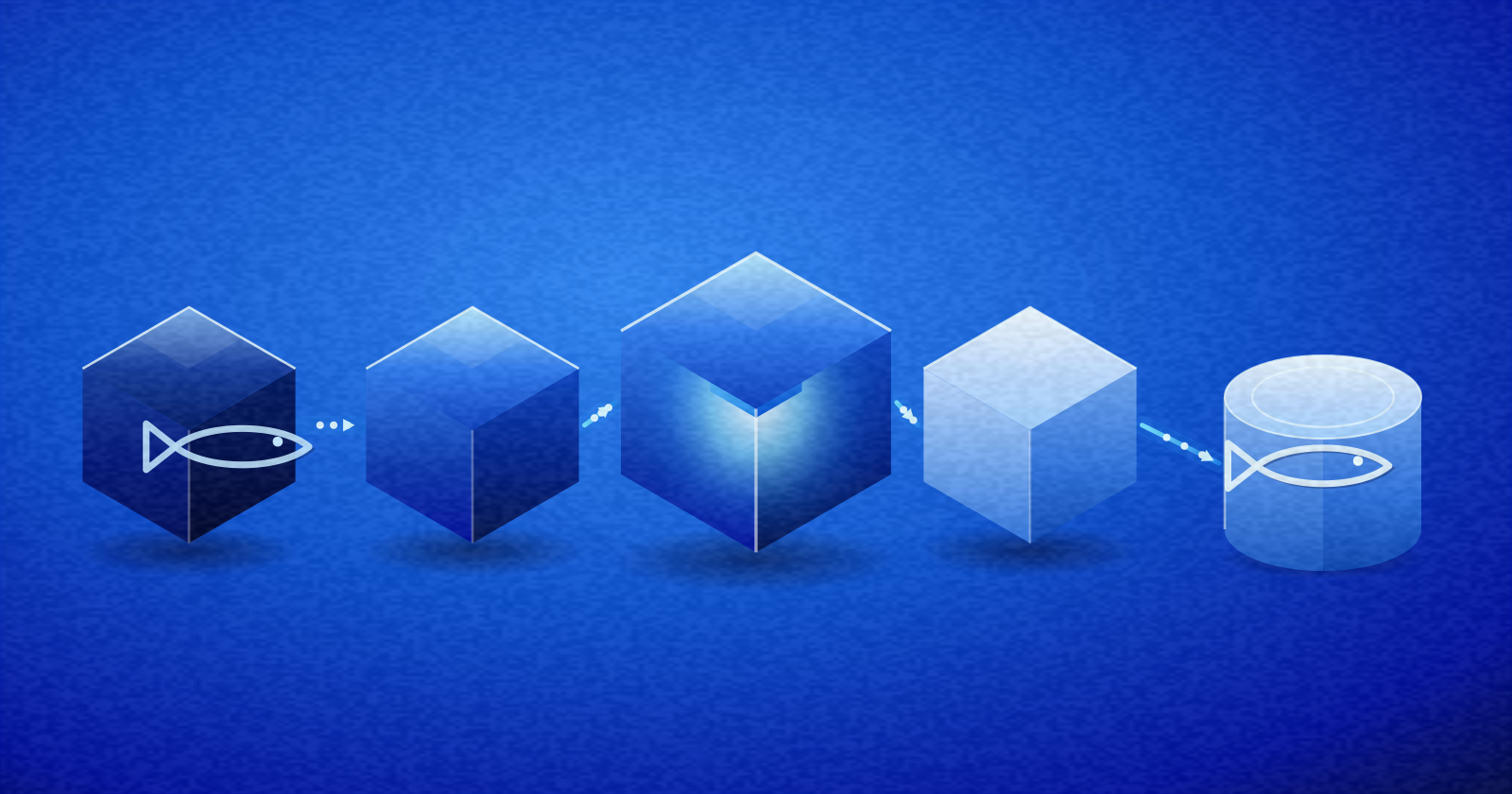
Pick up a tin of tuna and read the label. Dolphin-friendly. Line-caught. Responsibly sourced. It's a lovely set of promises, but how could you actually know any of it is true? You're trusting the brand, who's trusting a distributor, who's trusting a boat you'll never ride on. That's a long chain of "just trust me."
Blockchain supply chain traceability is one attempt to swap some of that faith for proof. To see how, we need to first unpack a word that sounds far worse than it is: trustless.
What "trustless" actually means
"Trustless" is an unfortunate name for a genuinely good idea. It does not mean no one can be trusted. It actually means you don't have to trust any single person or company for the system to work — because the system is built so that cheating is both very hard and very obvious.
Think of a group holiday with a shared kitty. If one person holds the cash, everyone's trusting that one person. Now picture the opposite: every member keeps an identical, running notebook of every payment, and no entry counts until most of the notebooks agree. Nobody's in charge, yet the books still balance. Fiddling your own notebook gets you nowhere, because everyone else's copies disagree with you.
That, in a nutshell, is a blockchain: a shared record, copied across many participants, where the group — not a boss — agrees on what's true. (We covered how that agreement, or "consensus", works in an earlier post if you want the mechanics.)
From the ocean to your trolley
So how does this help us with the tin of tuna?
Every time the fish changes hands, a new entry is added to its story, most of it happening automatically. The fish is tagged the moment it's landed, and the catch is logged in an app: what it is, where and when it was caught, and who caught it. After that, scanners on the boat, at the dock and in the processing plant read the tag and add each step to the record, with no one re-typing anything. When the fish is sealed into cans, each new product gets its own entry, linked back to the original catch. By the time it reaches the shelf, all of it sits behind a QR code on the tin: scan it with your phone, and you can follow the fish back to the boat. One caveat to note, though: this proves the record hasn't been altered since it was written, not that the very first entry was true. The tag and the automatic location check are there to make that first record harder to fake.
This isn't hypothetical. A well-known pilot project led by WWF set out to track tuna all the way from "bait to plate" across the Pacific, tagging each fish and recording its journey step by step. The result is a provenance trail you can follow back — from the shelf, to the distributor, to the person who pulled the fish out of the sea. And it's the same idea whether you're tracing tuna, tomatoes, medicines, or car parts. Scan a code, and the story of the thing in your hand is right there.
Why it's so hard to cheat
Here's the part that makes it powerful. Because each record is linked to the one before it, you can't quietly edit a single entry. Changing one link means changing every link that came after it — effectively rewriting a whole history book to alter one sentence. On top of that, the record doesn't live in one place. It's copied across the network, and the copies constantly check each other. Not all “nodes” — the computers that keep the network running — hold a full copy of every transaction, but many do. On a large public network there can be tens of thousands of these full copies: this is like a lot of friends with notebooks, all documenting the holiday kitty! And to force through a fake version of events, it isn't enough to run a lot of those computers — you'd need to control more than half of the network's computing power at once, so your version out-votes everyone else's. On a network that big, that's wildly impractical.
So fraud doesn't become impossible, exactly. It becomes so difficult, so expensive, and so visible that it usually isn't worth attempting.
What supply chain traceability actually buys us
When provenance is this hard to fake, some useful things follow.
Transparency, first. Anyone with permission can inspect the trail rather than taking a company's word for it. That matters most for the ethical claims — "sustainably caught", "conflict-free", "not made with forced labour" — that have long been easy to assert and hard to verify.
It also squeezes out corruption. A lot of dishonesty hides in the gaps between organisations, where one party's paperwork doesn't have to match another's. A shared ledger closes those gaps. That was a core aim of the tuna project: the same industry has seen reports of illegal fishing, trafficking, and forced labour, and a tamper-resistant trail makes those far harder to bury. If the records have to line up at every step, there's much less room to swap in cheaper stock, forge a certificate, or make a shipment quietly vanish.
One honest caveat
Blockchain is powerful, but it isn't magic — and it's worth being clear about the limits.
A blockchain can prove a record hasn't been changed since it was entered. It can't prove the record was true when someone typed it in. If a dishonest supplier tags the wrong fish as ethically caught at the very start, the blockchain will faithfully protect that lie forever. The old rule still holds: garbage in, garbage out.
That's why traceability works best alongside trustworthy checks at the point of entry — inspectors, sensors, tamper-proof tags. Blockchain secures the journey. But it still relies on honesty starting at the door.
The long and short
Even with that caveat, supply chain traceability like this is a real change: a lot of “just trust me” can now become “go and check” — and your tin of tuna might have to splash in some more verifiable promises.
Networks like these lean on infrastructure that stays secure, fast, and always on, which is exactly the kind of reliable foundation OVHcloud is built to provide.
And if you missed how blockchains reach agreement in the first place, our explainer on how blockchain works is a good next stop.