
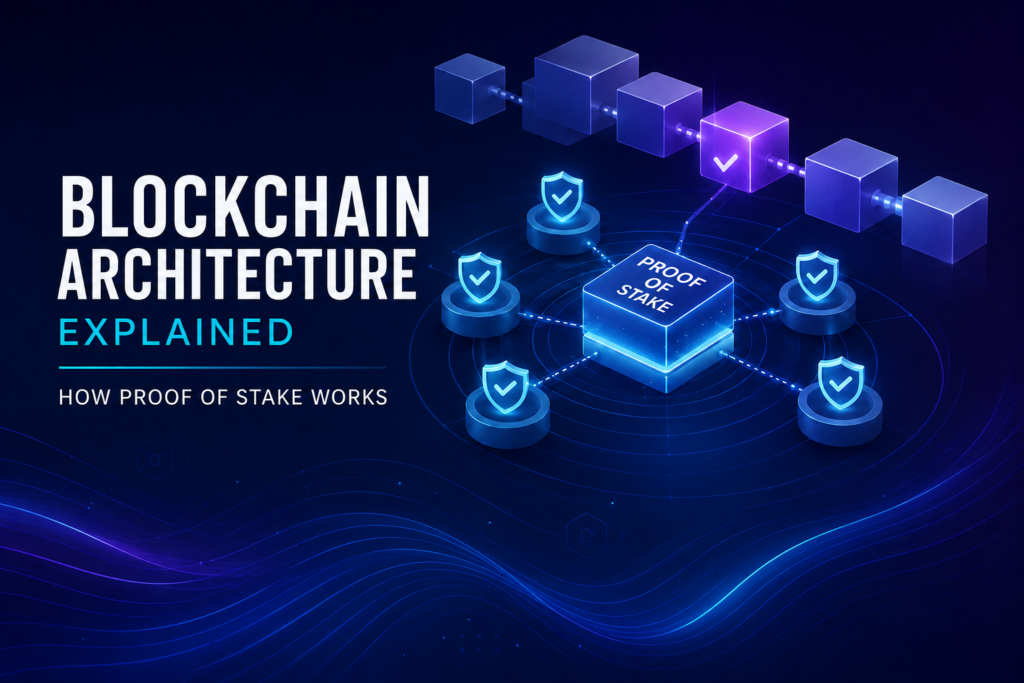
When people talk about blockchain, they are usually talking about the visible parts: cryptocurrencies, wallets, tokens, or applications built on top. But underneath all of that sits the whole architecture that makes the system work.
Like any structure, the underlying architecture matters. In blockchain, the structure determines how transactions move through the network, how they are validated, how the ledger stays synchronised, and why some blockchains can process payments or smart contracts much more efficiently than others.
In this article, we will take a look “behind the scenes” of the intricacy of a typical blockchain architecture built around a proof of stake consensus mechanism. We will also look at why Layer 2 networks exist, and how rollups help blockchains scale without simply pushing all activity through the main chain. But let’s begin at the beginning.
We start with the user
Every blockchain transaction begins with a user and an application.
The application might be a wallet, a decentralised finance platform, a marketplace, or another decentralised app. The user signs the transaction with their private key, which proves that they are authorised to move assets or trigger a smart contract action.
At this stage, nothing has yet been added to the blockchain itself. The transaction is simply a request: “I want to send these funds,” or “I want to interact with this application.”
The next step is getting that request into the network.
The role of RPC nodes and the gateway layer
Like all networks, traffic and requests go through several different stages before they are completed. Most users do not connect directly to the deepest parts of a blockchain network. Instead, transactions are usually submitted through an RPC node — short for remote procedure call node.
Think of the RPC node as an access point, or a gateway that will get you there. It receives requests from wallets, apps, and developer tools, and passes them into the blockchain system. In high-traffic environments, this layer may also include load balancers, proxies, or caching systems to help distribute demand and keep services responsive.
This matters because blockchain networks are not just ledgers. They are also live digital systems that need to handle large volumes of incoming activity. If the access layer is poorly designed, the user experience will suffer long before validation even begins.
Once the transaction has entered the network through this gateway layer, it moves on, closer to the validation process.
The mempool: the “waiting room” for transactions
After passing through the access layer, the transaction usually enters the mempool, or transaction pool.
The mempool is essentially a waiting area for transactions that have been submitted, but not yet finalised. The network checks that the request is valid in basic ways: that the signature is correct, that the sender has the required funds, and that the transaction format meets the network’s rules.
At this stage, the transaction has been submitted to the network, but it is not yet officially part of the blockchain. It is waiting in a queue until validators choose it, place it in the right order with other transactions, and add it to a block.
This matters because a transaction can be visible to the network before it is fully confirmed. In other words, the network can see that the transaction exists before it becomes a permanent part of the shared ledger.
How proof of stake validation works
Ready? This is where proof of stake comes in. The most important part of any blockchain network is validation, which checks the transaction ahead of being incorporated into the block.
In a proof of stake blockchain, the network does not rely on miners solving complex mathematical puzzles, as happens in proof of work systems. Instead, validation is handled by validators: participants who lock up a stake in the network, check the transaction, and are then rewarded for helping to secure it.
When transactions are ready to move forward, validators play a role in checking them and helping the network agree on what should be added next. A block proposer assembles valid transactions into a block, and other validators help confirm that this proposed block is legitimate.
The precise mechanics vary between networks, but the broad idea is the same: the chain moves forward because the network reaches consensus on the next valid state of the ledger.
This process is far more computationally lightweight than proof of work. Why is this useful? Because proof of stake is generally more energy-efficient than proof of work, and it is often better suited to blockchains that need higher throughput and lower latency. That efficiency is attractive to many enterprises.
From execution to block creation
Once a transaction has been selected, the network has to do more than simply store it. It must also process what that transaction means.
For a simple transfer, that may just mean moving a balance from one wallet to another. For a smart contract interaction, it may involve executing code. In Ethereum-based environments, for example, this happens through the Ethereum Virtual Machine, or EVM.
This execution layer matters because blockchains are not static databases. They are state machines. Every new valid transaction changes the state of the network, and the system must determine exactly what that new state is.
After execution, the transaction is incorporated into a block. That block is then proposed, validated, and distributed across the network.
Once consensus is reached, the block is added to the chain. The transaction is now confirmed as part of the shared ledger.
Full nodes, propagation and the distributed ledger
Let’s move on. After a block is accepted, it does not stay in one place. It is propagated across the peer-to-peer network so that the blockchain remains synchronised.
This is where full nodes play an important role. Full nodes store the blockchain’s history and verify the validity of blocks and transactions. Together, they help maintain the integrity of the distributed ledger.
That distributed structure is a core part of blockchain’s appeal. Instead of one central authority updating one private database, many participants maintain and verify the ledger together. That is what gives blockchain its combination of transparency, resilience, and decentralisation.
Why Layer 2 exists
So far, this all sounds logical. But it also raises a problem — read on.
If every transaction has to move through the main chain, validated and recorded in the same shared environment, what happens when activity explodes?
What happens is congestion.
Layer 1 blockchains are powerful, but they are not infinitely scalable. If too many low-value or high-frequency transactions compete for space on the main chain, speed can drop and costs can rise.
This is why Layer 2 networks have become so important.
Layer 2 sits above the main blockchain and handles part of the workload elsewhere, while still ultimately relying on the security of the Layer 1 chain.
In practical terms, this means that large volumes of activity can happen off the main chain, with results later passed back and settled on Layer 1.
How rollups work
If you’ve gotten this far, you’re doing well. Now it’s time to learn about one of the most important Layer 2 approaches: the rollup.
A rollup gathers many transactions together, processes them off the main chain, and then submits the result back to Layer 1 as a bundled update. This reduces pressure on the main blockchain and helps improve throughput. These transactions have to be verified as well, but when they are smaller transactions, networks can be less rigorous about verification. However, there are still processes involved, and
There are two major trust models here.
Optimistic rollups assume that submitted transactions are valid unless challenged. This makes them fast and efficient, but it also means there is usually a contest period during which invalid transactions can be disputed.
Zero-knowledge rollups, often called ZK rollups, use cryptographic proofs to demonstrate that the transactions are valid without revealing all of their underlying details. This can provide strong efficiency and privacy benefits, while reducing the need for long challenge periods.
Once the transaction has been verified in this way, it is incorporated into a block with many other smaller transactions, and passed back to the Layer 1 blockchain.
Both optimistic and ZK models aim to answer the same question: how do you scale blockchain activity without abandoning trust?
That is the real architectural challenge. Layer 2 systems are not simply shortcuts. They are engineering responses to the limits of Layer 1.
Why blockchain architecture matters
It is easy to think of blockchain as a single thing, but in reality it is a stack of interacting layers — a structural foundation.
First, there is the user-facing application. The gateway layer that receives transactions. Then the mempool that holds them. The validator layer that checks and orders them. The execution environment that updates the state of the chain. The full nodes that preserve and distribute the ledger. And, increasingly, the Layer 2 systems that help the whole model scale.
Understanding that architecture helps explain why blockchain performance depends on more than the chain alone. It depends on networking, validation design, software layers, and the infrastructure choices all working together.
That is also why blockchain architecture is now such an important topic for builders, operators, and IT leaders alike. The question is no longer simply “what is blockchain?” — it is “how does this system actually work at scale?”
And the answer lies in the masterful architecture behind it.

Elena Luoto
Creative Copywriter, OVHcloud.
American and French, Elena performs copywriting, editing, storytelling, brand strategy, English teaching, and interview/voiceover work at OVHcloud in Paris.

Omar Abi Issa is an award winning Blockchain Expert, with over 7 years of experience working with clients in the B2B SME/Enterprise areas. Specialising in helping tech companies with a strong focus on blockchain sector achieve higher performance and lower operational costs.

Adnan Patka
Adnan Patka is a blockchain expert at OVHcloud, based in London, UK. He is focused on supporting blockchain professionals and organisations in finding effective infrastructure solutions to their technical challenges, mapping security, reliability and infrastructure value against their business needs.