

They say superheroes are evolved humans. VMware Cloud Foundation 9 is becoming the evolved private cloud platform.
Not just a routine upgrade, VCF 9 represents an entire shift in how private cloud infrastructure is built, operated, and consumed, efficiently and cohesively.
When companies have traditionally modernized their infrastructure, they’ve upgraded it in pieces: whether compute, networking, storage or automation tools. But over time, this discombobulation can cause problems, including configuration inconsistency, upgrade schedule variations, tool sprawl, complex dependencies, higher operational risk…
Until today.
VCF 9 is reframing this old model, so that private cloud operations and cloud consumption can sit at the center of the platform, able to be upgraded in a coordinated, stack-wide manner. Unified by a single lifecycle engine and a consistent policy model, they can now enjoy integrated automation across the full stack.
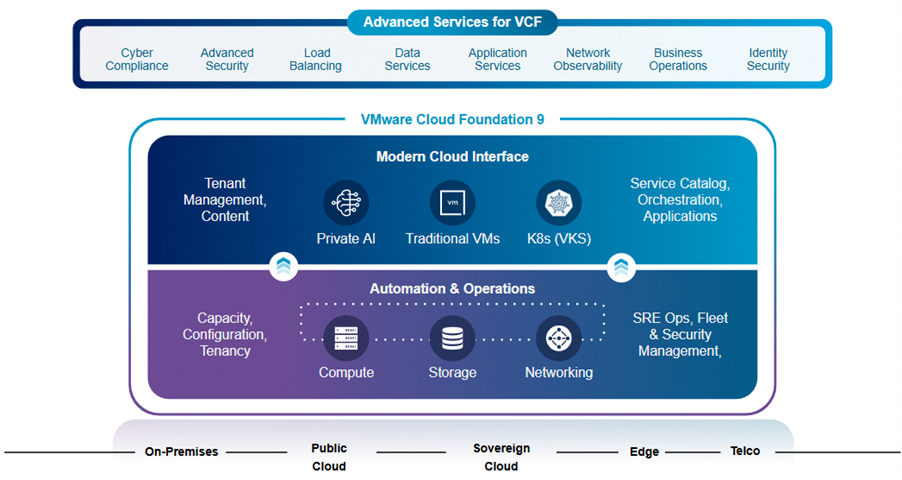
For those organizations who may be modernizing VMware environments – especially those consuming managed services such as OVHcloud’s upcoming Private VMware Cloud Foundation as-a-Service – this shift has measurable operational and economic impact. They are being rescued by a new full-stack software platform, you might say.
Read on to better understand the future of VMware Cloud Foundation 9, and what it means for the future of private cloud.
1. One Interface for Private Cloud Operations
VCF 9 provides a unified operational experience through the VCF Operations Console.
Instead of managing lifecycle tasks across disconnected tools, administrators are gaining centralized visibility for:
- Fleet-wide lifecycle management
- Security posture and compliance
- Certificate and identity management
- Diagnostics and health monitoring
- Global upgrades and patch orchestration
This reduces one of the biggest hidden costs in enterprise infrastructure: operational drift.
According to an IDC Business Value study sponsored by Broadcom, organizations running VCF environments have reported:
- 61% faster deployment of new workloads
- 34% lower infrastructure costs compared to traditional three-tier environments
The key driver is not just automation, it’s platform consistency.
For customers consuming managed VCF services, that will translate into more predictable maintenance windows and reduced operational risk.
2. A Unified Cloud Consumption Experience
Private cloud only delivers full value when it behaves like cloud.
VCF 9 strengthens the consumption model through VCF Automation, and is providing:
- A modern self-service interface
- Unified APIs for infrastructure provisioning
- Infrastructure as Code support
- Policy-based governance built into deployment
- Integrated Virtual Private Cloud (VPC) constructs for multi-tenancy
This allows infrastructure teams to offer curated service catalogs or developer-driven IaaS consumption models – without having to sacrifice governance.
Instead of tickets and manual coordination, application teams will now be able to provision:
- Virtual machines
- Networking constructs
- Storage volumes
- Kubernetes clusters
All governed by centralized policies. The result: faster delivery with controlled oversight.
3. Memory Tiering with NVMe: Production-Ready Efficiency
With VCF 9, Advanced NVMe Memory Tiering allows NVMe devices to function as a second tier of memory, intelligently placing memory pages to extend effective capacity without scaling DRAM costs linearly. In a context where infrastructure costs and hardware availability are becoming critical constraints, this capability helps organizations extract more value from existing servers.
Key enhancements in VCF 9 include:
- DRS and vMotion awareness
- Mixed-cluster flexibility (enabled on some hosts or all)
- Redundancy support via multiple NVMe devices
- Encryption at VM and host level
- Default DRAM: NVMe ratio shift to 1:1 (2× memory by default), customizable up to 1:4
Broadcom internal testing observed:
- Up to 40% TCO savings for most workloads
- Up to 25–30% increased CPU utilization
- Improved VM consolidation ratios
These results depend on workload profiles, particularly environments with high allocated memory but lower active memory.
In practical terms, Memory Tiering allows organizations to run more workloads on the same hardware footprint, improving infrastructure efficiency at a time when compute capacity, DRAM availability, and cost pressures are increasingly shaping infrastructure decisions.
4. Cost Transparency Built Into the Platform
Private cloud economics are increasingly under scrutiny. VCF 9 integrates:
- Chargeback and showback capabilities
- Capacity planning and optimization insights
- Cost allocation across tenants
- Predictive modeling for infrastructure scaling
According to VMware’s internal cloud economics analysis, organizations may be even able to achieve:
40% cost reduction compared to native public cloud alternatives
Again, results vary by environment, but cost predictability is a core advantage of modern private cloud operating models.
5. Security, Sovereignty, and Governance by Design
VCF 9 reinforces security as a built-in platform layer:
- Centralized identity federation
- Certificate lifecycle management
- Compliance monitoring
- Integrated security operations visibility
- VPC-aware segmentation
This matters for regulated industries and sovereign cloud environments, where operational consistency and policy enforcement are not optional.
Private cloud becomes less about “location” and more about operating model: governance is embedded into infrastructure.
6. What This Means for OVHcloud Customers
VMware Cloud Foundation 9 is also changing how service providers design managed environments.
To align with the domain-based architecture and lifecycle model introduced in VCF 9, OVHcloud is developing a new offer: Private VMware Cloud Foundation as-a-Service.
Key elements include:
- VCF license portability to OVHcloud
- Enforced Identity and Access Management (IAM) policies (avoiding local user models)
- Pre-configured vSAN hosts within cluster designs
- Seamless maintenance window scheduling
- Roadmap including 1-AZ and 3-AZ stretched cluster versions (currently in Alpha for business-critical workloads)
It’s important to distinguish:
- VCF provides the unified platform. OVHcloud builds the managed operational framework around it.
- The goal is not just to run VCF 9, but to operationalize it cleanly, and at scale.
A Strategic Version, Not a Cosmetic One
VMware Cloud Foundation 9 marks a fundamental shift:
- From component integration to unified platform
- From manual lifecycle orchestration to fleet-wide automation
- From infrastructure provisioning to cloud consumption models
- From siloed tooling to consolidated operations
For infrastructure architects and CTOs, this version matters because it reduces friction across the entire private cloud lifecycle.
Less manual intervention.
More deterministic upgrades.
Better resource efficiency.
Stronger governance.
And for managed service customers, it means a private cloud that behaves like a cloud, but under your control.
VCF 9 is becoming the new private cloud platform built to meet modern demands head-on. Super, by design.
Find out more about VMware on OVHcloud: https://www.ovhcloud.com/en-ie/solutions/vmware/
Join the Alpha and be the first to test Private VMware Cloud Foundation as-a-Service: https://survey.ovh.com/index.php/547617?lang=en

Elena Luoto
Creative Copywriter, OVHcloud.
American and French, Elena performs copywriting, editing, storytelling, brand strategy, English teaching, and interview/voiceover work at OVHcloud in Paris.

Thomas Gatignon
Product Marketing Lead
From his passion for tech products and marketing, Thomas turns complex cloud and infrastructure technologies into meaningful value, real customer impact and new business opportunities.