
In a world where digital technology supports all day-to-day actions – from healthcare, production, and education to security and decision-making – strategic autonomy becomes a fundamental priority.
Here, digital technology extends beyond just tools and applications to a complete system with infrastructures, platforms, software, data, streams, operating models, and governance rules.
Strategic autonomy is an organisation’s ability to manage its IT systems while retaining control over its data, infrastructures, and tech choices, regardless of external factors and limitations.
Far from being a theoretical concept, continuing to operate, innovate, and modernise without relying on third parties, or under poorly-controlled conditions, is a major operational issue. This elevates independence in organisational decision-making and behaviour to a strategic priority.

| Synopsis: Strategic autonomy is becoming a key concern for organisations today. It involves keeping a firm grip on IT infrastructures, ensuring data protection, and proactively managing risks that arise from tech dependency. The rapid uptake of AI is amplifying these challenges, and increasingly hybrid and distributed IT systems point to the need for a simpler, more unified, and consistent management strategy. Achieving autonomy requires regaining control over several structural levers. Infrastructure resilience, data governance, and protection against vendor lock-in should be the core elements of a long-term IT strategy, anchored in a clear and well-managed framework that can sustain usage over time. It’s becoming clear that current approaches are no longer enough. Neither the agile, rapidly deployable public cloud nor the more controlled, slow-to-evolve traditional on-premises IT systems can fully address the emerging technical, operational, and regulatory challenges facing organisations. A different path is coming into focus: The On-Prem Cloud Platform. OPCP offers a different cloud approach, integrating modern features, agility, and control within a system managed on-site. |
Why strategic autonomy is now a primary focus
Digital technology: a strategic challenge
Digital technology is no longer just a support for business operations; it has become their backbone. Any interruption in service, no matter how short, can lead to immediate and noticeable outcomes. In manufacturing or retail, this translates to halted production or delivery issues. In healthcare, this can disrupt care delivery or prevent medical teams and patients from accessing vital data. In the public sector, local services are often the most affected, sometimes on a large scale.
As IT systems become more critical, business continuity has shifted from a purely technical concern to a strategic challenge. Deep knowledge of infrastructure and how to deploy applications is essential for long-term success. And there can be no guarantee of operations without actual control. Moreover, when unexpected interruptions occur, businesses suffer revenue declines, incur repair costs, and miss out on potential opportunities, all stemming from issues like project delays, service outages, or weakened customer relationships.
Data is both a resource to protect and an asset to harness
Data is now a core strategic asset across a wide range of fields: industry, science, medicine, finance, and the public sector. It’s worth as much as critical infrastructure or business expertise. It also fuels operational processes, supports decision-making, boosts an organisation’s edge over rivals, and influences its ability to innovate.
This pivotal role highlights why its location, processing, and governance can no longer be left to accidental outcomes. A lack of proper data management opens the door to numerous potential threats. Data could fall under extraterritorial legal frameworks, erode intellectual property rights, be accessible via built-in platform tools or APIs, and potentially enable unchecked AI applications.
Strategic autonomy specifically consists of maintaining control over these decisions. It requires defining rules, knowing where data resides, tracking its flow, managing user access, and setting access permissions. Instead of responding to external pressures, actions should be guided by a deliberate, consistent strategy that aligns with the organisation’s priorities.
Tech dependency is a systemic risk
Today, many organisations are locked into digital environments they can’t fully manage, driven by solution sprawl, tight project deadlines pressures, and proprietary system integration. Tech dependency takes various forms, but its effects converge.
Operational flexibility is limited by factors such as difficult-to-replace proprietary technologies, complex and rigid architectures, unpredictable pricing, opaque third-party AI services, and contractual obligations that make migrations lengthy, costly, or risky. These dependencies hinder modernisation, stifle innovation potential, and steadily erode available strategic options.
Limiting them does not mean giving up on the cloud or outsourcing. It’s about regaining agility over time, restoring scaling capacity, and retaining control over tech decisions. These three factors are essential for managing IT systems sustainably and with proper oversight.
AI amplifies data control challenges
The accelerating use of AI is a driving force. Training, adjusting, or even simply running AI models involves handling massive volumes of sensitive data. Risks for critical workloads significantly increase when they are hosted in uncontrolled environments.
As a result, expected benefits may be jeopardised by potential leaks, closer regulatory scrutiny, loss of competitiveness, and challenges in maintaining audit traceability or compliance. AI offers a decisive advantage, but only if organisations maintain control over its deployment environments and the data it consumes.
The hybrid approach and distributed IT systems
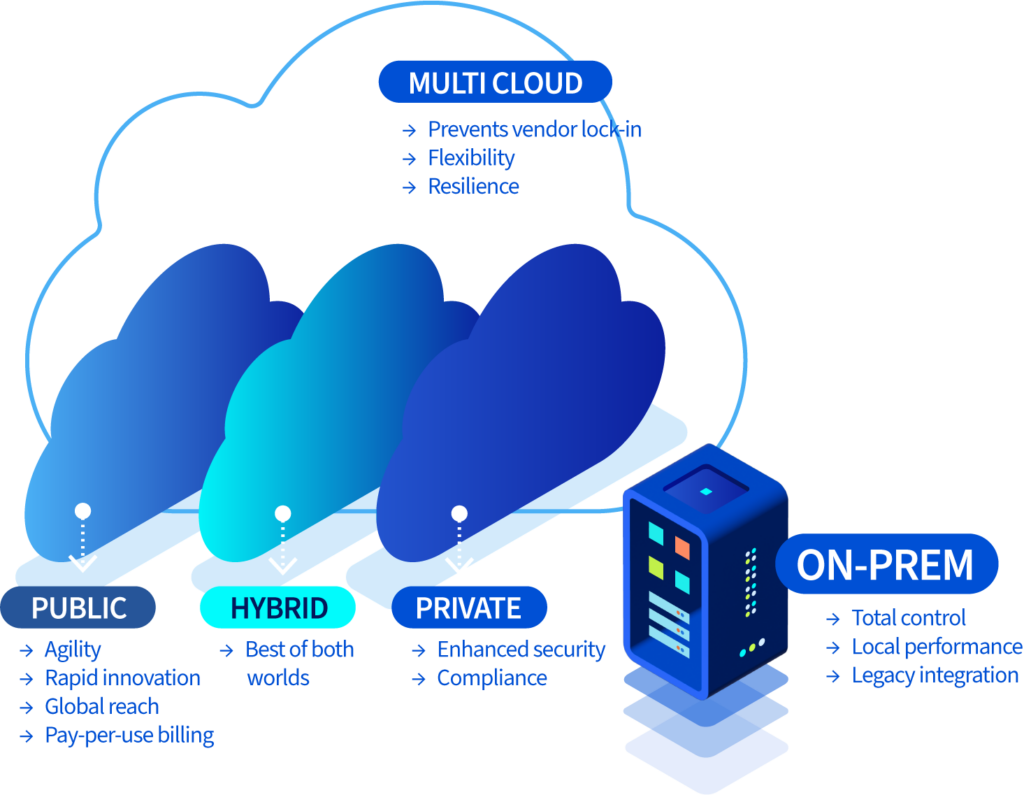
IT infrastructure options range from public and private clouds to SaaS solutions, edge computing, on-site datacentres, legacy systems, and cloud-native platforms, often built up in layers over time as projects, opportunities, and business needs evolve. This results in an increasingly fragmented, heterogeneous, and interdependent IT landscape.
Each environment comes with its own tools, security requirements, operational constraints, and cost models. At an organisational level, achieving consistency, ensuring security, enforcing rules, and staying within budget become core challenges. As these environments expand, operational complexity increases, raising the likelihood of silos, failure points, and unclear cost structures.
Relying on ad hoc decisions or local adjustments is no longer a viable strategy. An integrated strategy is therefore needed to bring environments into alignment, standardise processes, secure operational flows, and ensure stable operations on a large scale. This is exactly what strategic autonomy, when reflected upon in a structured way, facilitates. It helps organisations regain the ability to make informed choices, steer their direction, and build a controlled digital trajectory, rather than passively adopting new tech and becoming overdependent.
How to build strategic autonomy
Levers for maintaining control
Strategic autonomy can’t simply be declared; it requires active effort, grounded in informed decision-making and robust IT systems that can adapt to uncertainty without stifling innovation. The goal isn’t to halt current progress, but to create an environment where digital systems are robust, scalable, and well managed.
Several structural levers are key to achieving this. Alone, none of them are enough. It’s their collective, well-integrated application that enables the regaining of lasting control.
Lever #1: Designing a resilient and multi-source architecture
Ensuring business continuity is not just about avoiding outages – it’s about being able to switch, distribute, absorb, or isolate loads during an incident, while maintaining access to critical services. With a resilient architecture, essential applications are guaranteed to be available, even when conditions are less than perfect, allowing for continuity despite unforeseen events.
In practical terms, this involves:
- using various execution environments to reduce reliance on any one system;
- planning autonomous, local, or hybrid fallback scenarios to address different types of incidents;
- adding the resilience to handle peak demand and unexpected downtime;
- ensuring strategic services are accessible, regardless of where they are or the type of infrastructure they use.
These measures do not eliminate risks entirely, but they provide oversight over critical infrastructures and services, leading to secure, transparent, and proactive management of IT systems.
Lever #2: Establishing strict data governance
The organisation revolves around its data. Clear and rigorous governance is crucial for leveraging this asset strategically, and mitigating compliance, security, and confidentiality risks. Without rules and careful monitoring, data can become dispersed, exposed to uncontrolled uses, or fall under unintended foreign laws.
In practical terms, this implies:
- mapping data streams and dependencies between systems;
- setting clear processing limitations, with granular access permissions;
- ensuring thatsensitive data does not circulate in unsafe environments;
- choosing solutions that allow for control over legal and operational requirements;
- monitoring transfers, copies, and integration with third-party services.
Structured governance keeps data secure, consistent, and accessible, enabling informed decision-making based on reliable and contextualised information.
Lever #3: Avoiding lock-in and maintaining tech freedom
Strategic autonomy requires the freedom to make choices and implement them over time. This doesn’t mean excluding specific suppliers, but ensuring that every tech choice can be easily changed or reversed.
In practical terms, it involves:
- relying on open standards to facilitate interoperability;
- opting for portable and modular environments;
- decoupling different tech layers to reduce dependencies;
- negotiating contracts that provide flexibility for future changes;
- assessing potential costs and the feasibility of transitioning, even before a solution is chosen.
By adopting these practices, organisations can limit the risk of becoming overly dependent, allow technical teams more autonomy, and boost their capacity for growth without external pressures.
Lever #4: Framing the use of AI
While AI offers significant opportunities, its unchecked use can put sensitive data at risk. Strong governance is therefore crucial to turn this potential into tangible benefits.
In practical terms, this requires:
- defining the models used and their training scopes;
- restricting the use of sensitive data in unmonitored setups;
- monitoring and limiting shadow AI (unsupervised AI use within an organisation);
- ensuring traceability and supervision of all internal and external uses.
A well-defined framework enables organisations to leverage AI while ensuring security, compliance, and confidentiality.
Lever #5: promoting sustainable innovation that’s compatible with control
Strategic autonomy thrives on a stable and well-managed environment that supports rapid innovation without compromising the broader IT ecosystem.
Specifically, this comprises:
- an easy-to-understand and controlled architecture, simple to operate and adapt;
- the standardisation of tools and processes to reduce complexity;
- clear insight into costs and dependencies;
- a durable technical foundation, designed to last several years without major overhauls;
- the capability to integrate new technologies without having to rewrite everything.
Quick advancements are key to sustainable innovation, but they must be balanced with control over the entire system and its consistency.
The limitations of current approaches
Many organisations navigate between different models without ever finding the right balance to achieve true strategic autonomy.
The public cloud has transformed the way IT systems are deployed and operated. With increased speed, automation, and scalability, everything achieves a new level of agility. But this speed carries drawbacks, particularly the risk of becoming reliant on a single provider, occasional unpredictability in spending, and diminished ability to manage the infrastructure where critical data and applications reside.
In contrast, on-premises private clouds create a sense of total control. The infrastructure falls directly under the organisation’s responsibility and is within its scope. But this control has its limits, including operational complexity, the need for specialised expertise, lack of industrialisation, and difficulties in scaling up the infrastructure at the same pace as usage.
Local and immediate needs can be met by either hyperconverged solutions or edge architectures. While they perform well in specific domains, their limitations are evident when creating fully integrated, standardised, regulated, and scalable IT systems. On their own, they fall short of supporting a modern, sustainable cloud strategy at scale.
These three strategies are converging and a new approach is taking shape. It combines expertise in critical infrastructures and data, the modern use of cloud tech, and the freedom afforded by open standards. This approach strikes a balance between performance, resilience, and strategic autonomy – unlike conventional approaches, which are hobbled by inherent trade-offs.
On-Prem Cloud Platform: balancing cloud capabilities, control, and agility
This new approach no longer forces a choice between modernisation, control, and flexibility. Named On-Prem Cloud Platform (OPCP), the solution designed by OVHcloud provides a complete, industrialised, and modern cloud environment directly within the walls of an organisation.
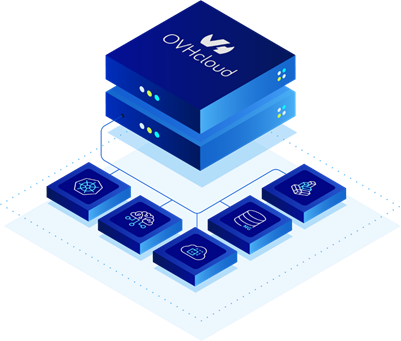
Built on 25 years of industry expertise, OPCP combines hardware and software through its internal operating system: OPCP Core System. This architecture is designed to deliver high performance, high availability, and business continuity, with the added benefit of complete on-site manageability. It thus meets the needs of demanding and regulated sectors, such as industry, healthcare, or the public sector.
With OPCP, infrastructure is no longer a remote black box. It becomes a clear, controlled, and supervised foundation, delivering the benefits of a modern cloud, including automation, standardisation, and rapid deployment. All without giving up control over infrastructure, data, or usage.
This model can run critical, sensitive, and strategic workloads in an environment where the rules, scope, and interconnections are clearly defined. It’s equally suited for modernising legacy applications as it is for hosting of AI services, data platforms, or edge and air-gapped solutions requiring proximity and responsiveness.
OPCP is based on standardised open technologies, designed to minimise lock-in and protect freedom of choice. This creates a natural hybrid foundation, capable of interacting with other cloud environments without compromising an organisation’s strategic autonomy.
In essence, OPCP offers a well-rounded digital transformation strategy through a cloud that gives back control, stabilises your infrastructure, makes management easier, and enables innovation at your own pace – free from provider dependency or architectural limitations.
Modernising without giving up control
Strategic autonomy is no longer limited to sensitive or powerful sectors. It’s becoming the core foundation for organisations looking to build a sustainable, controlled digital environment capable of withstanding global uncertainty.
As tech dependencies increase – especially with data flowing quickly and sometimes chaotically, and AI accelerating and transforming uses – regaining control is more than just a defensive posture. It’s a way to move forward by making deliberate choices, rather than being forced to go along with them.
This is where On-Prem Cloud Platform comes in. OPCP isn’t different for the sake of it; it’s amodern, industrialised and managed cloud – deployed in the right place. It aligns closely with the demands for continuity, control, and innovation that today’s organisations face.
Modernising your information system should never mean sacrificing your freedom to choose. An approach like OPCP enables agile innovation, in-depth transformation, and flexibility for new uses, all while maintaining consistency, transparency, and autonomy in decision-making.
A solid, sustainable, and secure digital environment is no longer abstract; it’s now a practical possibility, requiring careful planning, transparency, and autonomy.

Nicolas STEVENIN
On-Prem & Sovereign Solution Marketing Manager