
As both the cyberattack cause and cure, ever-expanding AI has been transforming cybersecurity from both sides of the battlefield. Organizations increasingly use AI to detect threats and automate security operations, but just as rapidly, attackers are also adopting AI to generate malware, accelerate phishing campaigns, and probe systems at scale.
As cyber threats evolve, cybersecurity education must evolve with them. Accordingly, future security engineers need more than theoretical knowledge — they need hands-on experience building and defending modern cloud environments against increasingly intelligent attacks.
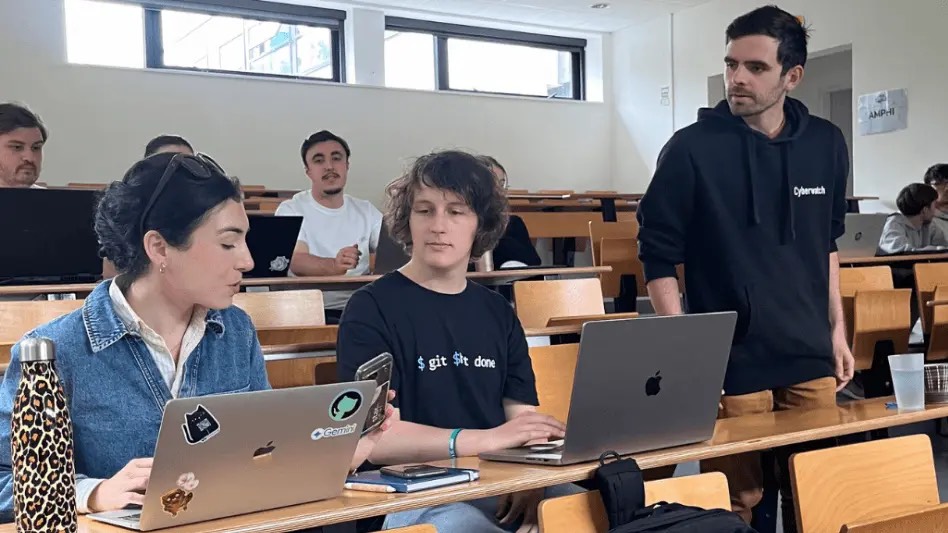
This was the exact goal of the recent OVHcloud x EPITA Rennes SecDevOps Hackathon. Students spent three days developing cloud-native security solutions designed for an AI-driven threat landscape, helping train the next generation of tech talent.
Why AI is changing cybersecurity education
Traditional cybersecurity education often focuses on known attack patterns or defensive tools in isolation. But today’s security teams are operating in a very different reality.
Analysts now work across AI-assisted detection systems, cloud-native infrastructure, threat intelligence platforms, and automated incident response workflows. At the same time, attackers are using AI to automate reconnaissance, generate convincing phishing content, and adapt their techniques faster.
Preparing students for this environment means moving beyond classroom theory. They need realistic infrastructure, collaborative development, and hands-on security engineering under real technical constraints.
That is where hackathons can make the difference: they push students to solve practical cybersecurity problems in conditions much closer to the ones they will face in the field.
Building cloud-native security solutions
As part of the OVHcloud Education program, students from EPITA Rennes’ SecDevOps major were given access to OVHcloud Public Cloud infrastructure alongside AI credits and development resources. Working in teams, they designed, tested, and deployed solutions capable of addressing emerging cybersecurity challenges while operating in production-like cloud environments. Rather than focusing on theoretical concepts, every project tackled practical problems security teams increasingly encounter today.
Rethinking cyberdefense in the age of AI
Several projects reflected how defensive security is evolving alongside AI:
MIR[AI]GE: turning AI attackers against themselves
Awarded Best Technical Project, MIR[AI]GE explored a proactive approach to defending against autonomous AI attacks.
Instead of simply blocking malicious activity, the platform detects offensive AI agents and redirects them into isolated honeypot containers filled with realistic — but entirely fake — data.
The objective is not only to stop the attack but also to waste the attacker’s computing resources while gathering valuable behavioral information.
As AI-generated attacks become more sophisticated, deception technologies like honeypots are becoming increasingly valuable components of modern cyberdefense strategies.
Find out more: miraige.vercel.app
Honeymind: threat intelligence from attacker behavior
Winner of the Best Presentation Award, Honeymind focused on generating actionable threat intelligence.
The team developed an internet-facing honeypot capable of analyzing attacker requests before enriching the collected data with AI, improving deception techniques and producing insights that security operations teams could use during incident response.
Projects like this demonstrate how AI can support defenders — not only by automating analysis but by making security systems themselves more adaptive.
Discover the repository: github.com/al2al85/HoneyMind
Other innovative approaches
Other teams explored complementary security challenges:
Winnie developed a bounce honeypot that guides attackers through AI-generated environments inspired by the MITRE ATT&CK framework.
Meanwhile, SRE-squad created an assistant designed for SOC analysts, helping correlate logs with operational runbooks and prioritize alerts in environments increasingly flooded with AI-generated attack traffic.
Together, these projects illustrate how future security professionals are beginning to combine cloud infrastructure, automation, and AI into practical defensive workflows.
What organizations can learn
While the hackathon centered on students, the technologies they explored mirror challenges many organizations already face.
Modern cybersecurity increasingly relies on:
- Cloud-native security architectures
- Threat intelligence pipelines
- AI-assisted analysis
- Deception technologies such as honeypots
- Automated security operations
As these capabilities become mainstream, organizations will need engineers who understand both software development and security engineering — the core principles behind SecDevOps.
Providing students with opportunities to build these systems today helps the next generation of cybersecurity professionals prepare for tomorrow’s threats.
Supporting the next generation of security engineers
The OVHcloud Education program aims to bridge academic learning with real-world cloud engineering by giving students access to production-grade infrastructure and practical technical challenges.
The hackathon also offered members of the winning teams a fast-track interview with OVHcloud’s technical recruitment teams for their end-of-studies internships.
A special thank you goes to Gabin, Lucas, and Magali, whose mentorship and expertise helped make this year’s event a success.
If you’re ready to turn AI cybersecurity training into a career, explore opportunities on the OVHcloud Careers site. And if your institution would like to organize a hackathon with the OVHcloud Education program, we’d love to hear from you.

Elena Luoto
Creative Copywriter, OVHcloud.
American and French, Elena performs copywriting, editing, storytelling, brand strategy, English teaching, and interview/voiceover work at OVHcloud in Paris.
